


How to Use Exercise Bands: Six Simple Exercises to Build Strength at Home | #WSWWellness

Written by #WSWWellness Sponsored by Wall Street Wraps
You do not need a room full of gym equipment to start strength training. A resistance band, some clear floor space, and a manageable routine can be enough to get moving.
Exercise bands provide resistance as you stretch them, allowing you to challenge your muscles without using dumbbells or weight machines. They are a practical option for home workouts, and current guidance from the American College of Sports Medicine recognizes elastic bands as an effective way to improve strength and physical function.
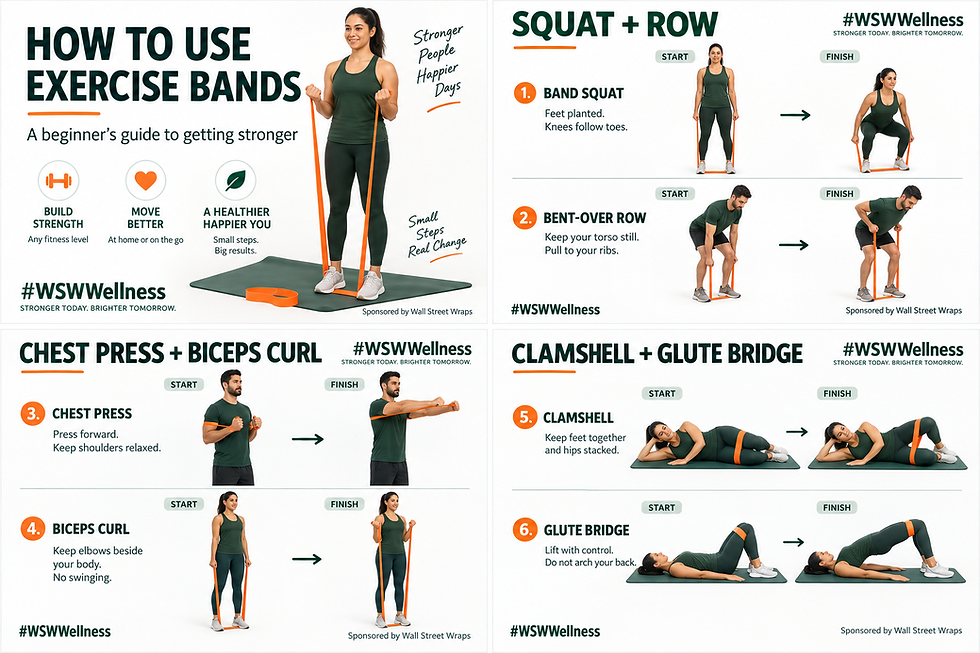
This guide covers six exercises: squats, bent-over rows, chest presses, biceps curls, clamshells, and glute bridges. Start with light resistance, learn the movements, and build from there.
Choose the Right Band
For this routine, have a long exercise band for the standing exercises and a short loop band for the clamshells and glute bridges. An exercise mat will make the floor exercises more comfortable.
Choose resistance that lets you complete the movement smoothly while still making your muscles work. A band is too challenging when you need to swing, lean, or shorten the movement to finish. Different exercises may require different resistance levels. Do not select a band simply because it looks strong. Select one you can control.
Before You Start
Inspect your bands before every session. Do not use one with cracks, tears, damaged handles, or loose connections. Follow the manufacturer’s instructions, including its maximum stretch limit. Keep bands away from sharp edges, and never release a stretched band suddenly.
For exercises that involve standing on a band, wear secure footwear and position the band beneath the middle of your feet—not just under your toes. This routine does not require a door anchor or attachment to furniture.
Warm up with approximately five minutes of walking or marching in place. During the exercises, keep breathing: breathe out during the effort and breathe in as you return. Stop an exercise that causes pain rather than trying to push through it.
1. Band Squat
Focus: Legs and buttocks.
Stand with your feet approximately shoulder-width apart, securing the middle of a suitable long band beneath both feet. Hold an end or handle in each hand, with your arms down beside you.
Bend at your hips and knees, lowering your body as though you are sitting down. Keep your feet planted and your knees moving in the same direction as your toes. Lower only as far as you can comfortably control, then press through your feet to stand again. The lowering and standing phases together count as one repetition.
Keep your arms steady rather than turning the movement into a curl. Use a band length and resistance appropriate for this position; do not overstretch a short band.
Form reminder: Control the depth. A comfortable, steady squat is the starting point. Practice without the band first when learning the movement.
2. Bent-Over Row
Focus: Back and pulling strength.
Stand on the middle of your long band and hold an end in each hand. Soften your knees and push your hips backward, allowing your upper body to lean forward. Keep your back in a comfortable neutral position rather than rounding your shoulders toward the floor.
Starting with your arms reaching downward, pull your hands toward your lower ribs. Let your elbows travel backward while keeping your torso still. Pause briefly, then lower your hands slowly.
Form reminder: Move your arms, not your whole body. Avoid standing up with every pull or jerking the band to create momentum.
3. Chest Press
Focus: Chest and pushing strength.
Place a long band across your upper back, below your neck, and bring the ends forward beneath your arms. Hold your hands near chest level with your elbows bent.
Press forward until your arms are nearly straight, then return slowly. Keep your shoulders relaxed and avoid leaning forward to finish the movement.
Form reminder: Use a lighter band when you cannot press smoothly without shrugging or changing your posture.
4. Biceps Curl
Focus: Front of the upper arms.
Secure the middle of a long band beneath your feet. Hold the ends with your palms facing forward and your arms beside your body.
Bend your elbows to bring your hands toward your shoulders. Keep your elbows close to your sides, then lower slowly without letting the band snap your arms downward.
Form reminder: Keep your body still. Swinging your torso is a sign to reduce the resistance.
5. Clamshell
Focus: Muscles around the outer hips.
Place a short loop band around your thighs, just above your knees. Lie on your side with your knees bent, your legs stacked, and your head supported by your lower arm or a cushion.
Keep your feet touching as you lift your top knee. Open only as far as you can without rolling your pelvis backward. Pause, then lower your knee slowly. Complete your repetitions before changing sides.
Form reminder: Keep your hips stacked. The goal is to move at the hip while keeping the rest of your body quiet—not to open your knee as widely as possible.
Start without a band when you are still learning to control the movement.
6. Glute Bridge
Focus: Buttocks and controlled hip movement.
Lie on your back with your knees bent and your feet flat on the floor, approximately hip-width apart. Rest your arms beside you. For the banded version, position a light loop band around your thighs, above your knees.
Gently tighten your abdominal muscles and squeeze your buttocks as you lift your hips. Keep your knees aligned with your feet. Lift only as high as you can without arching your lower back, then lower slowly to the floor.
Form reminder: Do not chase height. A controlled lift with a steady lower back matters more than pushing your hips as high as possible.
Learn the basic bridge without a band before adding resistance.
Put the Exercises Together
Here is a suggested starting routine
.
After warming up, perform one set of 8–12 controlled repetitions of each exercise, completing the clamshell on both sides. A repetition is one complete movement; a set is a group of repetitions performed before resting.
Rest approximately 60–90 seconds between exercises, or longer when needed to regain comfortable breathing and good control. Finish a set early when your technique begins to change.
Start with two sessions per week, leaving at least one full day between sessions. For example, try Monday and Thursday rather than two consecutive days. General activity guidance recommends strengthening all major muscle groups at least twice weekly, while recovery time allows the muscles you have trained to rest.
These six movements are an introduction, not an exhaustive training program. As you become more confident, a qualified trainer can help you develop a balanced routine for your goals and abilities.
How to Make Progress
Make control your first measure of progress. Can you complete the movement without swinging? Can you return slowly? Can you keep your posture steady from the first repetition to the last?
When your current routine becomes comfortable, change one thing at a time. Add a few repetitions within your chosen range, add a second set, or move to a slightly stronger band. Avoid increasing everything at once. Gradually increasing resistance as an exercise becomes easier is a standard strength-training progression.
You also do not need to push every set to the point where another repetition is impossible. Current ACSM guidance emphasizes regular participation and appropriate effort rather than requiring training to muscle failure for general fitness.
A useful habit is to record the exercise, band used, and repetitions completed. Compare your progress with your own earlier sessions—not someone else’s workout.
Keep Strength Training in Perspective
Resistance bands are one part of an active lifestyle. Continue making room for walking, cycling, dancing, swimming, or other aerobic activities you enjoy. Strength work and aerobic exercise serve complementary roles; one does not replace the other.
At #WSWWellness, our approach is straightforward: make room for movement, choose food thoughtfully, and build habits that fit your daily life.
Start with a band you can manage. Learn one movement at a time. Give yourself room to improve.
Stronger Today. Brighter Tomorrow.Sponsored by Wall Street Wraps. Real Food! Your Way!
This article provides general fitness information, not individualized medical advice or rehabilitation instructions. Consult a healthcare professional before starting when you have a medical condition, an injury, or concerns about exercising safely. A qualified fitness professional can help check your technique and adapt the movements.


Comments